Facial massage: Kobido, gua sha, natural lift, effectiveness and frequency

Facial massage covers very different techniques: some relax, others work the muscles in depth, others use a stone. Kobido and gua sha are the two names you come across most often; natural lift, or facial stretching, is a third approach. This guide explains what sets them apart, what the studies actually measure, how often to have them and when to refrain.
What is a facial massage?
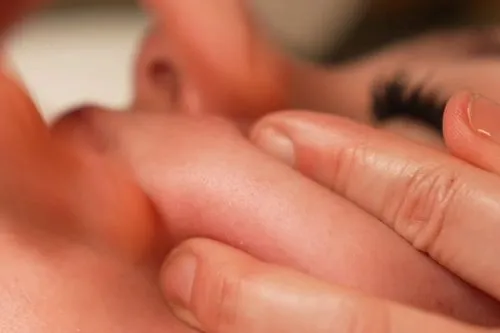
A facial massage is manual work on the skin, muscles and tissues of the face, the neck and often the décolleté. Depending on the technique, the movements are slow and enveloping, or fast and invigorating. It differs from a classic facial treatment, where most of the time is devoted to products.
The face has many small muscles, used all day long by speech and expressions. Massage mobilises them, stretches them and releases their tension. It is this muscle work, more than the skin itself, that is at the heart of the so-called “lifting” techniques.
Where does Kobido come from?
Kobido is a Japanese facial massage. The Japanese organisation that bears this name presents itself as a lineage more than five centuries old, devoted to passing on this art, and states that Kobido is a registered trademark in many countries. In institutes, the word commonly refers to an invigorating, rhythmic facial massage.
That age is the one claimed by the organisation itself: it belongs to tradition, not to independent historical research. What can be retained is the nature of the technique: fast sequences of light tapping, kneading and smoothing, on the face, neck and décolleté.
Kobido, gua sha, natural lift: what are the differences?
Kobido is a fast, invigorating manual massage. Gua sha is performed with a flat stone glided over oiled skin. Natural lift relies on slow, targeted muscle stretches. All three work on the face, neck and décolleté, but neither the rhythm nor the sensation is alike.
| Kobido | Gua sha | Natural lift | |
|---|---|---|---|
| Technique | fast tapping, kneading and smoothing | a flat stone glided over oiled skin | slow, targeted muscle stretches |
| Tool | the hands | a stone | the hands |
| Rhythm | sustained | slow | slow |
| Sensation | invigorating, stimulating | cool, enveloping | deep, stretching |
Gua sha comes from traditional Chinese medicine, where it is performed on the body with stronger pressure. Its facial version is much gentler. As for facialists’ methods, such as the LB method, they combine several of these movements in a made-to-measure protocol.
Does facial massage work?
The available studies are few and small. They show that massage temporarily increases blood flow in the skin, and one pilot study measured slight changes in the shape of the cheeks after two weeks of self-massage. Nothing demonstrates a lasting effect comparable to that of a medical procedure.
A Japanese study from 2018 measured, in twelve people, an increase in skin blood flow for at least ten minutes after five minutes of roller massage. In fourteen people, five weeks of daily use improved the response of the blood vessels to heat.
A pilot study from 2022, conducted on only five volunteers, observed by CT scan a slight upward shift of the cheekbone after two weeks of self-massage twice a day. Its authors themselves describe it as preliminary. No study indexed in PubMed deals with Kobido under that name (October 2026).
What can be said without exaggerating: a facial massage relaxes and gives a healthy glow in the moment. It is not a facelift.
Is it good to massage your face every day?
Yes, provided the movement stays gentle. The two studies cited above were based on daily self-massage. The problem is force, not frequency: firm, repeated massage can irritate the skin, and a case of muscle rupture has even been described after very vigorous massages.
That case, published in 2024 in a plastic surgery journal, concerned a woman who had long been massaging her face with a hard wooden block. It is exceptional, but it is a reminder that a face is not massaged like a back.
How do you massage your own face?
On clean skin with oil or cream, glide your fingers from the centre of the face outwards and from the bottom upwards, with light pressure: from the chin towards the ears, from the sides of the nose towards the temples, from the middle of the forehead towards the hairline. A few minutes are enough: it is maintenance, not a treatment.
A few precautions:
- clean hands and enough oil or cream for the fingers to glide without pulling on the skin;
- light pressure: the skin must neither stay red nor hurt;
- stop in case of inflamed spots, irritation or a wound.
These movements maintain relaxation and a healthy glow between two sessions. At Vernal, the Signature treatment includes learning a few self-massage movements to repeat at home.
How often should you have Kobido?
There is no research-validated frequency for Kobido in an institute. The rhythm depends on what you are looking for, occasional relaxation or regular work, on your skin and on your budget. It is decided with the practitioner, after a first session, and maintained with a few self-massage movements at home.
A single session mainly brings relaxation and a healthy glow. If you are looking for deeper work, regularity matters more than intensity, as with any muscle work.
What are the contraindications of facial massage?
Facial massage should be avoided on infected or damaged skin: an active cold sore, very inflamed acne, a wound, sunburn, an eczema flare-up. It should also be postponed after cosmetic injections or facial surgery, until the doctor has given the go-ahead.
- Recent injections or surgery: ask your doctor how long to wait.
- Ongoing dermatological treatment: mention it, some make the skin more fragile.
- Pregnancy: tell the practitioner, who adapts the position and the products.
- Unexplained pain, numbness or swelling of the face: that is a reason to see a doctor, not to have a massage.
These precautions are those applied to massage in general: there is no official list specific to Kobido or gua sha.
Facial massage at Vernal, in Tangier
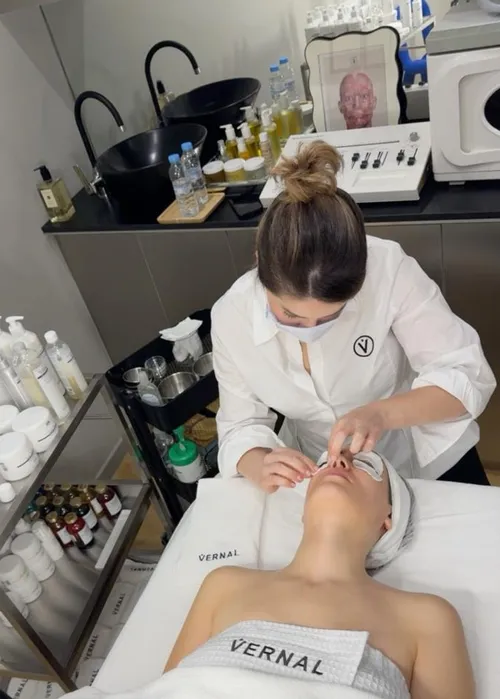
Vernal, a holistic beauty centre on Route de l’Abattoir in Tangier, offers eight facial massages, performed with Oden French botanical oils. The protocols are designed and performed by Hajar Dabbou, a facialist trained in the LB method, Kobido and facial gym.
| Massage at Vernal | Duration | Price |
|---|---|---|
| The Kobido Ritual · Japanese Lifting Massage | 60 min | 1,000 dh |
| The Sculpt · Gua Sha Massage | 60 min | 800 dh |
| The Stretching · Natural Lift Massage | 60 min | 800 dh |
| Signature Vernal · LB Facialiste Method | 75 – 90 min | from 1,200 dh |
The full menu and up-to-date prices are on the Facial massages page. For a treatment built around a skin diagnosis and products rather than technique, see the Biologique Recherche facial and all our facial treatments in Tangier.
Frequently asked questions
What results can you expect straight after a facial massage?
Relaxed features and a rosier complexion, because the massage temporarily increases blood flow in the skin. These effects are short-lived. A massage does not lastingly change the structure of the face in one session, and Vernal promises no measurable result.
Can you do Kobido on yourself?
You can massage your own face, with simple, light movements. Kobido is something else: a long, fast and precise sequence that the practitioner learns in training. Self-massage maintains; it does not reproduce a session.
Does gua sha leave marks on the face?
It should not. On the body, traditional gua sha is performed with pressure that reddens the skin. On the face, the stone glides with light pressure over oiled skin. Redness that lasts or a bruise means the pressure was too strong.