
Russian manicure, BIAB, gel polish: the differences and how long they last

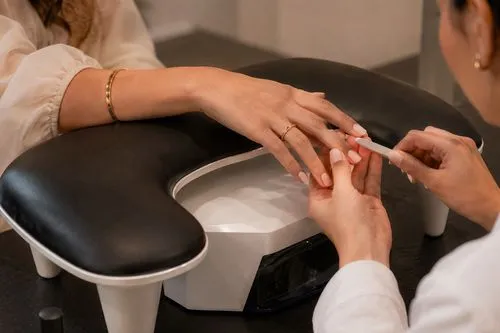
Russian manicure, BIAB and gel polish are not three versions of the same treatment. The first is a way of preparing the nail, the second a builder gel, the third a polish. They can be combined, which is what keeps the confusion alive. This guide explains what each one does, how long it lasts, its risks and how to remove it.
What is a Russian manicure?
A Russian manicure is a dry manicure: no water soak, no wooden cuticle pusher. The technician cleans the outline of the nail with an electric file fitted with small bits, then trims the skin with scissors or nippers. The result is a very clean outline, ready for a polish or a gel.
It is also called a dry manicure, a combined manicure or an e-file manicure. The name refers to a preparation technique, not a product: after a Russian manicure, you can apply a classic polish, a gel polish or BIAB.
What is the difference between a regular manicure and a Russian manicure?
In a regular manicure, the hands are soaked, the cuticles are softened and then pushed back, and the nail is filed. In a Russian manicure, everything is done dry with an electric file, and the cuticle is removed instead of being pushed back. The outline is cleaner, but the technique is more demanding and more invasive.
This difference explains both the appeal of the technique and the reservations of dermatologists, detailed below. It also explains why the training of the person holding the electric file matters so much: the same machine gives a clean result or an over-filed nail, depending on the hand.
What is BIAB?
BIAB stands for Builder In A Bottle: a builder gel applied with a brush, like a polish, and cured under a lamp. Thicker than a gel polish, it forms a layer that strengthens the natural nail and can be used to lengthen it slightly. It comes in natural or coloured shades.
The name comes from a range by the brand The GelBottle, sold as a soak-off builder gel to strengthen the natural nail. It has become a common term: many salons say “BIAB” for any builder gel in a bottle, whatever the brand used.
What is the difference between BIAB, gel and gel polish?
Gel polish is a polish: a thin, coloured layer cured under a lamp. BIAB is a flexible builder gel, thicker, which strengthens the nail and is removed by soaking. Classic hard gel is harder: it is used for extensions and long shapes, and is removed by filing.
| Gel polish | BIAB | Classic hard gel | |
|---|---|---|---|
| What it is | a polish cured under a lamp | a builder gel in a bottle | a builder gel in a pot |
| Thickness | thin | medium | thick |
| What it brings | colour | colour and strength | length and shape |
| Removal | by soaking | by soaking, or infill | by filing, or infill |
The Russian manicure is not in this table: it is done beforehand, whichever application is chosen afterwards.
How long do a Russian manicure, BIAB and gel polish last?
Wear time is counted in weeks for all three, and depends less on the product than on how the nail is prepared, how fast it grows and what the hands do. No duration is guaranteed. In every case, it is the regrowth at the base of the nail that ends up deciding the next appointment.
A few reference points, to be taken for what they are: the gel behind the name BIAB is sold with the promise of more than four weeks of wear. Advocates of the Russian manicure highlight a polish that does not chip for several weeks, because it is applied very close to the skin. Dermatologist Mona Gohara, who teaches at the Yale School of Medicine, says she has her own nails done every three weeks.
What extends wear time: nails that are dry and free of oil before the application, a product that does not touch the skin, gloves for washing up and cleaning. What shortens it: picking at the polish, using it as a tool, or putting off removal until the product lifts on its own.
What are the drawbacks and risks?
The main risk lies with the cuticle. It protects the area where the nail is made: cutting it opens the door to bacteria and fungi. Next come nails thinned by filing that is too heavy, and repeated exposure of the hands to the UV rays of the curing lamp.
On the Russian manicure, dermatologist Mona Gohara is clear: she lets no one touch her cuticles. Without that barrier, she explains in an article broadcast by the American network NBC, the nail is exposed to yeast, fungi and bacteria, which can cause an infection around the nail, with pain, swelling and sometimes lasting effects on the shape and strength of the nail. The American Academy of Dermatology gives the same advice: never let anyone cut or push back the cuticle.
On polishes cured under a lamp, the same academy reports nails that become brittle, peel or crack, and an increased risk of skin cancer and premature ageing of the hands with repeated use.
These risks are reduced with a few habits:
- check that the instruments are sterilised between clients;
- ask for the cuticle to be worked on as little as possible, and say straight away if it hurts;
- protect your hands before they go under the lamp, with sunscreen or gloves;
- moisturise the skin around the nails between appointments;
- show a doctor any finger that is red, hot or painful in the days that follow.
How do you remove BIAB or gel polish?
BIAB or gel polish is removed by soaking: the surface is filed to open up the product, then the nail is put in contact with a remover until the gel softens. It is never peeled off. BIAB can also be kept and simply topped up at the regrowth: that is an infill.
The American Academy of Dermatology gives two instructions for removal: soak only the fingertips in acetone, not the whole hand, and never pick at or lift the polish with a nail or a tool. Peeling off an application can take the top layers of the nail with it, leaving it thin and sensitive.
At Vernal, removing gel polish costs 70 dh and removing gel costs 100 dh.
How much do gel polish and BIAB cost at Vernal?
At Vernal, in Tangier, a manicure with gel polish costs 300 dh with Semilac polishes and 350 dh with Core or Manucurist. BIAB costs 350 dh with Semilac and 450 dh with Core, and from 400 dh to 550 dh with extensions, depending on the brand and the length.
| Treatment at Vernal | Price |
|---|---|
| Manicure + Semilac gel polish | 300 dh |
| Manicure + Core / Manucurist gel polish | 350 dh |
| BIAB Semilac | 350 dh |
| BIAB Core | 450 dh |
| BIAB Semilac + M or L extensions | 400 dh or 450 dh |
| BIAB Core + M or L extensions | 500 dh or 550 dh |
| Gel polish removal | 70 dh |
| Gel removal | 100 dh |
Up-to-date prices, pedicure included, on the Manicure, pedicure & nails page.
For the steps of a spa pedicure and how it differs from a medical pedicure, see our article on the spa pedicure.
Having your nails done at Vernal, in Tangier
Vernal, a holistic beauty centre on Route de l’Abattoir in Tangier, offers manicures with gel polish from 300 dh and BIAB from 350 dh, with or without extensions. The centre is open Monday to Saturday, from 10 am to 8 pm.
Tell the technician what you expect from the application, wear time or strengthening the nail, and mention any fragile or damaged nail: that is what makes it possible to choose between gel polish and BIAB.
Frequently asked questions
Does a Russian manicure damage the nails?
It can if the drill bit presses too hard or if the cuticles are removed too far: the nail becomes thinner and sensitive, and the skin around it can get infected. Pain or a burning feeling during the treatment is not normal. Tell the technician straight away.
Why have a Russian manicure?
For the clean outline of the nail and for wear time: the polish is applied very close to the skin, so regrowth shows later. It is an aesthetic choice. Dermatologists, however, point out that the cuticle protects the nail and advise against cutting it.
Should you take breaks between two gel polish applications?
The American Academy of Dermatology recommends it: leave the nails without polish for one to two weeks, or longer, between applications. It also advises seeing a dermatologist if a nail changes in appearance in a lasting way.
Is the UV lamp used to cure gel dangerous?
The American Academy of Dermatology states that repeated use can increase the risk of skin cancer and premature ageing of the hands. It advises applying a broad-spectrum sunscreen, SPF 30 or higher, before the application, or wearing dark fingertip-free gloves.
