Spray tan: how to prepare, what happens during the session and how long it lasts

A spray tan gives you a golden glow in a few minutes, with no sun and no UV booth. The result still depends a great deal on what happens before and after the session. Here is how it works, how to prepare, how a session goes, when to shower, how long it lasts and what it costs at Vernal.
What is a spray tan?
A spray tan is a self-tanner sprayed onto the skin as a fine mist by a professional. Its active ingredient is almost always DHA (dihydroxyacetone), a simple sugar. DHA reacts with the amino acids of the dead cells in the stratum corneum, the outermost layer of the epidermis, and forms brown pigments: this is the Maillard reaction, the same one that browns the crust of bread.
The sun prompts the skin to make melanin; DHA only colours the surface, with no UV and no melanin. Because the stratum corneum renews itself constantly, the colour goes away with the cells that fall off.
The tanning effect of DHA was discovered in the 1950s, and the first self-tanners on the market, released at the end of that decade, gave an orange tint that earned them a bad reputation. Today’s formulas are more nuanced, and professional solutions come in several intensities depending on skin tone. Many add a colour pigment that shows as soon as the product is applied, which guides the technique and gives an immediate tan; it washes off at the first shower, while the colour from the DHA keeps developing.
Spray tan or self-tanner: what is the difference?
The active ingredient is the same: DHA. What changes is the way it is applied, and therefore how even the result is.
| Self-tanner at home | Spray tan at a salon | |
|---|---|---|
| Active ingredient | DHA | DHA |
| Application | by hand or with a mitt, by yourself | sprayed as a mist, by a professional or in an automatic booth |
| Back, sides, ankles | hard to reach on your own | covered with successive passes |
| Intensity | that of the product chosen | adjusted to your skin tone and the effect you want |
Applied at home, a self-tanner also lasts a few days: three to ten depending on the product, according to Wikipedia.
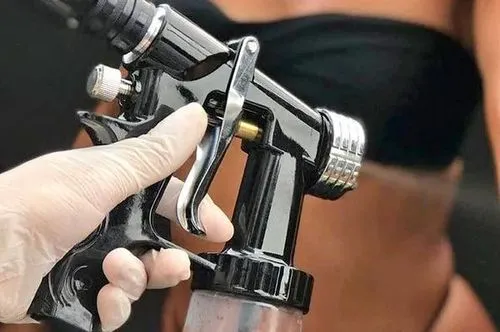
There are two ways to spray. In an automatic booth, the solution is diffused by nozzles in an enclosed cabin that looks like a shower. With a spray gun, the technician adjusts the distance, the amount and the number of passes zone by zone, and can go lighter on the hands and feet, where tan lines show the most.
How to prepare for a spray tan?
DHA colours dead cells. Dry, rough skin, or skin covered with a film of cream, therefore takes the colour unevenly. Preparation comes down to a few steps, as set out by the Botan brand:
- 24 to 48 hours before: a gentle scrub, focusing on the elbows, knees and ankles, without rubbing until the skin is irritated. A hammam visit with a kessa glove scrub works well, the day before or two days before rather than the same morning. Some professional scrubs are designed to be used just before the session: follow the product’s instructions in that case;
- at least 24 hours before: shaving; waxing 24 to 48 hours before, longer if your skin is sensitive, to give the redness time to go. Our advice on bikini waxing applies to the rest of the body;
- the days before: a moisturiser every day, especially on dry areas;
- on the day: clean, dry skin, with no cream, oil, perfume, deodorant or make-up on the areas to be tanned.
Before the session, mention any known allergy, any reaction to a self-tanner, any dermatological treatment or recent treatment that has made your skin more sensitive, such as a peel. If your skin is irritated, damaged, in an eczema flare-up or marked by sunburn, it is better to postpone.
What to wear for a spray tan?
You do not need to be naked during the session. You can keep your underwear on or wear a disposable pair; covered areas do not take the colour and leave a tan line, like a swimsuit. Choose the cut according to the outfits you plan to wear in the following days.
To leave, bring loose, rather dark clothes: a tight garment rubs on skin that has not been rinsed yet and can mark the colour.
How does a spray tan session go?
A session lasts 10 to 20 minutes according to Botan, a time that varies with the areas treated: a chat, spraying zone by zone, then drying. Here is how the brand describes a session with a spray gun.
The chat covers the effect you want, subtle or stronger, the occasion and any recent treatments; it is used to choose the intensity of the solution. Spraying then takes place in successive passes. The technician tells you as she goes how to position yourself: standing, legs slightly apart, arms away from the body, then side-on and with your back turned, so that the mist reaches the sides and the inside of the arms without building up in the creases.
The elbows and knees, where the skin is drier or thicker, get less product, because they turn darker. So do the hands and feet, to avoid tan lines at the fingers, wrists and ankles. The face calls for the same restraint, with a soft transition to the neck and décolleté. The mist is cool and slightly damp, with no heat and no contact; you get dressed once the solution has dried.
Spraying calls for a ventilated room and protected eyes and lips. The US Food and Drug Administration (FDA) only approves DHA for external application: not around the eyes, not on the lips and mucous membranes, and not by inhalation. It advises checking, before a spray tan, that these areas are protected and that you are not breathing in the mist, and asking for these protections if they are not provided.
When to shower after a spray tan?
After the solution’s development time: about 6 hours for a classic solution and about 2 hours for a rapid one, according to Botan. Follow the time your technician gives you. Until then, avoid water, sweating, exercise and rubbing. During this first shower, the water may be tinted: that is the colour pigment washing off, not the tan.
The colour itself keeps developing. According to the Cleveland Clinic, it starts to appear two to four hours after application and can keep darkening for 24 to 72 hours.
How long does a spray tan last?
About a week. The Cleveland Clinic says five to ten days, Botan seven to eight days for its solutions, with a colour that fades gradually and can remain noticeable for up to 10 to 15 days. The tan does not disappear all at once: it lightens at the pace of skin renewal. On the face, it often goes faster, because of make-up removal and daily skincare.
To make it last:
- moisturise your skin every day, with a cream free of oil and exfoliating ingredients;
- avoid scrubs, the hammam with a kessa glove and exfoliating treatments (acids, retinoids) for as long as you want to keep the colour;
- avoid showers that are too hot and repeated rubbing.
Before a wedding, a holiday or a photo shoot, Botan advises scheduling the spray tan one to two days beforehand: the colour has time to develop and the first shower is behind you.
Do you get tanned with a spray tan, and does it protect from the sun?
You get the colour of a tan, without the melanin. The skin keeps its usual sensitivity to UV: a spray tan does not protect against sunburn. The FDA also requires tanning products without sunscreen to say so on the label. The Cleveland Clinic recommends continuing to wear a broad-spectrum sunscreen of SPF 30 or higher before going out.
The day after the session calls for extra caution. A German study published in 2008 (Jung et al., Spectrochimica Acta) measured, under UV, far more free radicals in skin samples treated with a high dose of DHA than in untreated skin. The authors advise avoiding long sun exposure during the 24 hours after application and wearing sun protection.
Is a spray tan safe?
Most dermatologists consider it safer than the sun or UV booths, since it avoids UV. That does not mean it comes without precautions.
- Inhalation: the industry has not given the FDA safety data on inhaled DHA; the FDA has therefore not approved its use as a full-body spray in a booth. It reports cases of coughing, dizziness and fainting, mostly during booth sprays, without being able to say whether the product is the cause.
- The skin: rashes have been reported. DHA, and erythrulose, a self-tanning active ingredient that sometimes goes with it, can cause contact eczema, and the fragrances in some formulas irritate sensitive skin.
- Open questions: the Cleveland Clinic cites concerns about repeated inhalation, a small amount of DHA passing through the skin and, on cells in the laboratory, DNA damage; nothing has been shown in humans. In 2010, the European Scientific Committee on Consumer Safety (SCCS) concluded that sprayed DHA did not present a risk; specialists have criticised it for relying mostly on industry data.
During pregnancy, the manufacturer Botan does not present the spray tan as a contraindication. On the medical side, the dermatologist Jennifer Lucas, of the Cleveland Clinic, would rather advise abstaining if you can, or choosing a self-tanning cream instead, which is not breathed in. The doctor who follows the pregnancy remains the right person to ask.
How much does a spray tan cost in Tangier?
At Vernal, a spray tan costs 150 dh for the face and décolleté, 250 dh for half the body and 350 dh for the full body. Vernal uses the Botan spray tan, a formula of botanical origin. A body and face scrub can be added before the session to prepare the skin.
| Spray tan at Vernal | Price |
|---|---|
| Face & décolleté Spray Tan | 150 dh |
| Half-body Spray Tan (upper body or legs) | 250 dh |
| Full-body Spray Tan | 350 dh |
| Preparation option – Body and face scrub before Spray Tan | 100 dh |
For a first spray tan, say what effect you are after, from a simple healthy glow to a stronger tan, and the date of the event if there is one. The centre is located on Route de l’Abattoir, in Tangier.
Frequently asked questions
Can a spray tan look orange?
The first self-tanners, in the late 1950s, gave an orange tint. With today's formulas, that tinge depends mostly on the solution, the intensity chosen, how the skin was prepared and the application technique. Botan advises a moderate intensity for a first session; a gentle scrub before the session helps avoid darker patches on the elbows and knees.
Does a spray tan stain clothes?
Before the first shower, the colour pigment added to some solutions can leave temporary marks on clothes and bedding. Hence the advice to wear loose, dark clothing after the session, until the first rinse.
Can you go in the sun after a spray tan?
Yes, but with sunscreen: a spray tan does not protect against UV. A German study published in 2008 also measured more free radicals under UV in skin samples treated with a high dose of DHA than in untreated skin: its authors advise avoiding long sun exposure the day after application.
Can you get a spray tan while pregnant?
The manufacturer Botan does not present pregnancy as a contraindication to its lotions. On the medical side, a Cleveland Clinic dermatologist would rather advise skipping it if possible, and the Cleveland Clinic points out that it is not known whether exposure to DHA carries a risk during pregnancy. Ask the doctor who follows your pregnancy.
Does a spray tan smell?
The reaction of DHA on the surface of the skin gives off a smell, which the first self-tanners made unpleasant. It still exists; many formulas partly mask it with a fragrance.