
French manicure: classic, reverse or baby boomer, which base to choose and how long it lasts

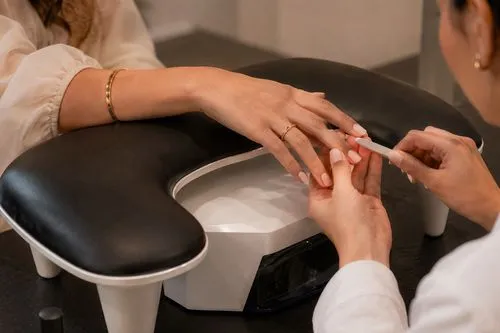
The French manicure is a nail salon classic, and one of the most reinvented: classic, fine, coloured, reverse or blended, on polish or on gel. Here is what sets these styles apart, which one to choose for your nails, how long it lasts and what it costs at Vernal.
What is a French manicure?
A French manicure combines a nude, pale pink or clear base with a light tip, traditionally white, painted on the free edge of the nail. The boundary between the two is called the smile line. A good French manicure is judged by how sharp that line is and how even it stays from one finger to the next.
The French manicure was not invented in Paris. The American nail polish brand Orly credits its founder, Jeff Pink, with creating it. As he tells it, a film director asked him for neutral nails that would go with every costume, so that actresses would not have to change their polish between scenes. He then showed the look at the Paris fashion shows and named it “French” on his way back. Wikipedia and Vogue date it to 1976.
What are the different French manicure styles?
They all keep a contrasting accent on a discreet base. They differ in where that accent sits, its colour and the way it meets the base.
- Classic French: a sharp white tip on a pink or nude base.
- Micro French: the tip shrinks to a very thin stroke along the free edge.
- Coloured French: the white tip is replaced by a colour, pastel, bright, metallic or glitter.
- Reverse French: the accent moves to the base of the nail, as a half-moon near the lunula.
- Baby boomer: the pale pink base gradually blends into the white tip, with no line.
| Style | Where the accent is | Dividing line |
|---|---|---|
| Classic French | at the tip of the nail | sharp |
| Micro French | at the tip, as a very thin stroke | sharp |
| Coloured French | at the tip, in colour | sharp |
| Reverse French | at the base of the nail | sharp |
| Baby boomer | at the tip, blended | none |
The term “reverse French” has a second meaning: in some acrylic application protocols, it describes a way of building the extension, unrelated to a half-moon at the base. To avoid any misunderstanding, show the nail technician a photo of what you want.
The origin of the name “baby boomer” is uncertain. It may refer to women born during the baby boom, who liked a natural manicure, or to pink and white, the two most popular polish shades of that time.
Which French manicure for which nail length and shape?
A French manicure works on every nail shape, short or long, round, square or almond, and the smile line follows that shape: a soft curve on an almond nail, an almost straight line on a square nail. The booking platform Treatwell describes the almond as a shape with an elegant curve, where the smile line stays soft.
On short nails, keep the tip thin. A thick white band compresses the nail and makes it look shorter; a micro French, or a line placed slightly higher on the nail, visually lengthens it. The baby boomer, with no visible line, also suits short nails.
What to apply a French manicure on: polish, gel polish, BIAB or gel?
A French tip can be painted on regular polish, on gel polish cured under a lamp, on a builder gel such as BIAB, or on gel or tip extensions. A baby boomer can also be done with polish on natural nails or with builder gels.
The base product determines how long it lasts, how much it strengthens the nail and how it is removed. These differences, and how to remove gel polish or BIAB without damaging the nail, are covered in our article on Russian manicure, BIAB and gel polish.
How long does a French manicure last?
A French manicure lasts as long as the product it is applied on: five to seven days on regular polish before the first chips according to Treatwell, a few weeks on gel polish or gel.
Its particularity is that wear shows in one specific place. The tip of the nail and its sides take the knocks, the keyboard and the phone screen: that is where the white chips first. Typing with the pads of your fingers rather than your nails helps keep the tip neat. On gel polish or gel, a chipped tip should be removed at the salon: scraping it off also takes away the surface of the nail.
How to do a French manicure at home?
You need a base coat, a nude or pink polish, a white polish for the tip and a top coat. The steps:
- file the nails to the shape you want and degrease them;
- apply the base coat, which protects the nail and helps the polish last;
- apply the nude polish and paint the white tip, always in the same direction, with a brush, a French pen or round stickers used as a stencil;
- finish with a top coat, which protects the design.
The difficulty lies in the smile line: drawing it evenly on ten nails takes practice, especially with the hand you do not usually use. A baby boomer is harder still: in 2019, ELLE Belgium considered it too complex to reproduce on your own. For a French manicure on gel polish or gel, you also need a curing lamp, whose repeated use exposes the hands to UV: the precautions are covered in our article on BIAB and gel polish.
Is the French manicure still in fashion?
In 2019, ELLE Belgium said it had been overtaken by the baby boomer. In an article updated in July 2026, the nail polish brand Manucurist presents it as back in the spotlight, in reverse, ombré, glitter or coloured versions. For a wedding, Treatwell still considers it the reference style.
How much does a French manicure cost at Vernal?
Vernal’s menu lists the French and the baby boomer among its finishes: the French is 70 dh and the baby boomer 100 dh. The applications they are done on, regular or long-lasting polish, BIAB, false nails or gel extensions, have their own price on the menu.
| Finish at Vernal | Price |
|---|---|
| French | 70 dh |
| Baby Boomer | 100 dh |
All prices, applications, pedicure and removals included, on the Manicure, pedicure & nail bar page.
Getting a French manicure at Vernal, in Tangier
On Route de l’Abattoir, in Tangier, Vernal’s nail bar offers manicures with regular or long-lasting polish, BIAB, false nails and gel extensions, as well as French and baby boomer finishes. To get the French manicure you have in mind, tell the nail technician where to place the accent, at the tip or at the base, how wide it should be, its colour, and whether you want a sharp line or a gradient.
Frequently asked questions
What is the difference between a French manicure and a baby boomer?
A French manicure draws a sharp line between the nude base and the white tip. A baby boomer blends the two colours into each other: the pale pink base gradually turns white towards the tip of the nail, with no visible line.
Does a French manicure suit short nails?
Yes, as long as the line stays thin: a thick white tip makes a short nail look shorter. The micro French, a barely visible stroke along the free edge, is often recommended for short nails.
Can a French manicure be done on BIAB or gel polish?
Yes. A French tip can be painted on regular polish, gel polish or a builder gel such as BIAB. It then lasts as long as the product it is applied on.
Does a French manicure damage the nails?
The design itself does not: it is just one more coat of polish on the tip. What can damage the nail is the base product and its removal: filing that is too heavy, gel polish or gel peeled off instead of being dissolved, and repeated applications without a break. These risks are the same with or without a French tip.
