Head massage: how a session goes, how long it lasts and what you can really expect

A head massage relaxes the head, neck and shoulders in 15 to 30 minutes, without undressing. Its best-known form comes from India, where it is traditionally done with a hair oil. Here is how a session goes, how long it lasts, what studies measure, who should avoid it and what it costs.
What is a head massage?
A head massage is a massage of the scalp, most often extended to the neck and shoulders, sometimes to the face. It is done with the pads of the fingers: pressure, friction, kneading and effleurage make the skin of the scalp move over the bone. Its first aim is relaxation, and it is received fully clothed, with or without oil.
Where does Indian head massage come from?
Indian head massage is called champi in Hindi. It is a massage of the head, face, neck, shoulders and upper back, according to Wikipedia, generally done with a hair oil. It remains common in India, with almond, amla or neem oils, sometimes scented with sandalwood or jasmine.
The French word shampooing comes from the English shampoo, borrowed from the Hindi chāmpo, “to oil, to massage the muscles”, notes the French-language Wikipedia. At the beginning of the 19th century, an Indian entrepreneur, Sake Dean Mahomed, made it known in England, in his baths in Brighton. The word only took on the meaning of washing the hair later.
The name “champissage” is a registered trademark, formed from champi and “massage”.
How does a head massage session go?
There is no single sequence. In the programme of a 2016 Korean study, the session begins with stretches, massages the shoulders and neck, moves up to the base of the skull, then the scalp, temples, ears and face, and ends with stretches. The order and pressure change from one practitioner to another.
The strokes in detail:
- the warm-up: a few stretches, for two to three minutes;
- the shoulders: thumb and wrist pressure, kneading between the fingers;
- the neck and the base of the skull: the muscles are grasped and stretched downwards, then the base of the skull is massaged;
- the scalp, temples and face: zigzag massage, wave-like movements, small flicks, light strokes and fingertip tapping, circles on the temples, massage of the ears and face;
- the end: a few stretches, for two to three minutes.
The massage is received sitting or lying down, depending on the salon. If a pressure feels too strong, especially on the neck, say so: the practitioner will lighten it.
How long does a head massage last?
Allow 15 to 30 minutes for a head massage. These are the durations tested in studies: 15 or 25 minutes in the 2016 Korean study, 30 minutes for the neck and shoulder massage in an American study on headaches. At Vernal, in Tangier, the scalp massage lasts 30 minutes.
Allow a few more minutes to straighten your clothes and, if the massage was done with oil, to redo your hair.
What are the benefits of a head massage?
The benefit you can expect from a head massage is a moment of relaxation. A small study suggests a measurable effect on stress, but there is no basis for promising more: head massage is not a treatment, and its effects on headaches or hair growth remain poorly established.
The 2016 Korean study followed 34 female office workers aged 20 to 49. Two groups received a massage of the scalp, neck and shoulders lasting 15 or 25 minutes, twice a week for ten weeks; a third group received none. After the ten weeks, cortisol and noradrenaline, two hormones linked to stress, had fallen more in the women who were massaged than in the group without massage.
This is an encouraging result, but a limited one: few participants, and no group receiving a sham massage to separate out the effect of simple rest. The US National Center for Complementary and Integrative Health (NCCIH) notes this for several types of pain, including neck and shoulder pain: when massage brings relief, it is often short-lived.
Does head massage relieve headaches?
It can help you relax when a headache comes from stress, but studies do not prove that it works better than a sham treatment. The UK’s National Health Service (NHS) lists massage among the relaxing activities that can relieve a tension headache, alongside exercise and yoga.
Tension headaches, which are very common, cause pain on both sides of the head, face or neck, with a feeling that the head is being squeezed, according to the NHS. Stress, sleep problems and caffeine are among their common causes.
Two American studies tested a massage targeting specific tension points in the neck and shoulder muscles (trigger points):
- in 2002, a study gave eight 30-minute massages over four weeks to people suffering from chronic tension headaches. The headaches became less frequent, not less intense. But only four people completed the study, which the authors acknowledge as a major limitation;
- in 2015, partly the same team split 56 people into three groups: head and neck massages, a sham treatment (a detuned ultrasound device) or a waiting list. Headaches became less frequent with the massage as well as with the sham treatment, with no difference between the two. Yet the people who were massaged felt that their pain had decreased more.
The NCCIH sums up: studies on massage and headaches are few, and their results are inconsistent.
A headache that comes back several times a week, that is severe, or that neither painkillers nor relaxation relieve should be checked by a doctor, the NHS points out.
Does head massage make hair grow?
There is no basis for promising that. A 2016 Japanese study involved only nine men without hair loss, massaged every day for four minutes with a device: after 24 weeks, their hair was slightly thicker. That is too little to draw conclusions from, and the study did not involve massage by hand.
In this study, the average thickness of a hair went from 0.085 to 0.092 mm. The abstract describes no comparison group, and two of the five authors worked for a private company, ANGFA. In case of hair loss, a dermatologist is the person to see.
Who should avoid head massage?
Massage carries few risks, according to the US National Center for Complementary and Integrative Health (NCCIH). Still, postpone a head massage if you have a wound, irritation or infection of the scalp, a fever, or a recent head or neck injury. An unusual or sudden headache should be seen by a doctor before any massage.
Serious adverse effects of massage are rare, according to the NCCIH. Some of the reported cases involved vigorous massages or people more prone to injury, such as older people. The NCCIH advises never to put off a medical consultation for a massage.
The NHS asks you to see a doctor quickly if a severe headache comes with:
- jaw pain when eating;
- blurred or double vision;
- a scalp that is sore to the touch;
- numbness or weakness in the arms or legs.
A sudden and very severe headache, or one that follows a blow to the head, needs emergency care.
Before the session, also mention a pregnancy, recent surgery, neck problems or an allergy to an oil: the practitioner can adapt the massage.
How do you give yourself a head massage?
Place the pads of your fingers on your scalp and make small, slow circles, moving the skin rather than rubbing the hair. Start at the forehead, move up to the crown, then down towards the nape of the neck. Finish with the temples, the base of the skull and the upper shoulders.
For a tension headache, the 2002 and 2015 studies worked on the base of the skull and the upper shoulders; the 2002 study also worked on the temples:
- the base of the skull, just above the neck, where the small muscles that hold the head are attached;
- the upper shoulders, between the neck and the shoulder;
- the temples, where the muscle you use to clench your jaw is located.
Press without causing pain, a few minutes at a time. These studies involved massages received from someone else, not self-massage, whose effect on headaches has not been measured.
How much does a head massage cost at Vernal?
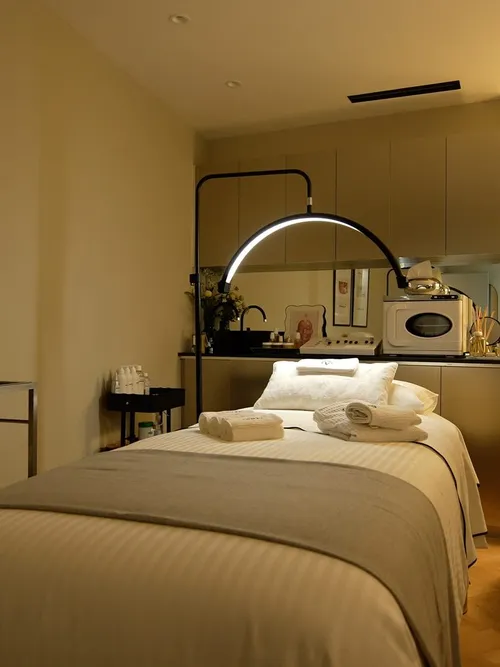
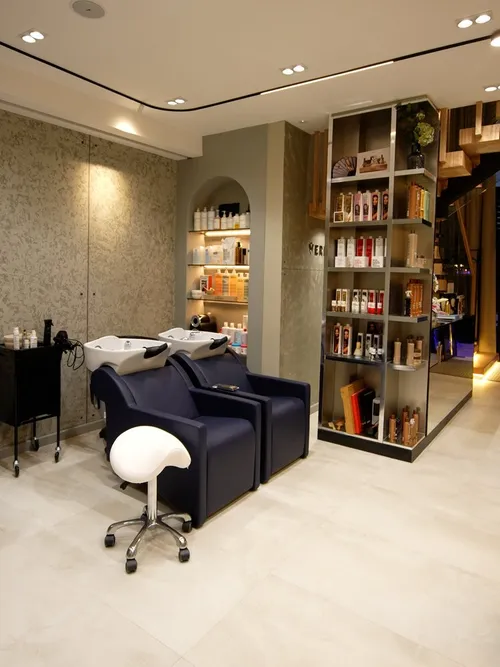
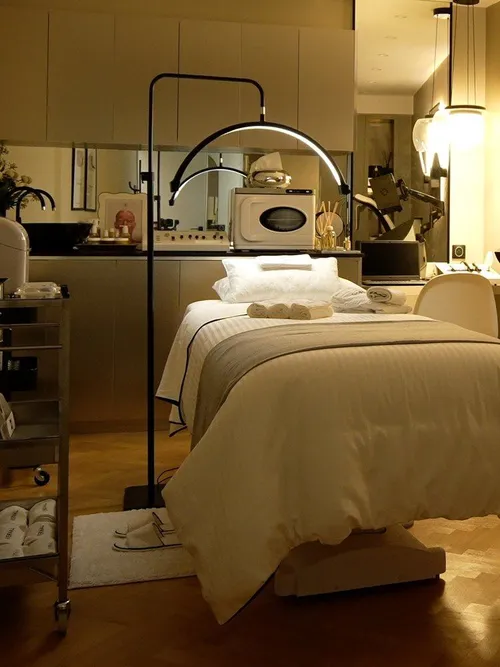
At Vernal, a beauty centre on Route de l’Abattoir in Tangier, the scalp massage costs 300 dh for 30 minutes. The menu describes it as a relaxing massage of the scalp, neck and shoulders; it is listed with the body massages.
| Massage at Vernal | Duration | Price |
|---|---|---|
| Scalp massage | 30 min | 300 dh |
| Relaxing massage | 60 min | 450 dh |
| Relaxing massage | 90 min | 600 dh |
For a full-body massage, the relaxing massage and the hot stone massage are presented in our guide relaxing massage or hot stone massage. The head spa is presented in our guide and on the Head Spa page.
Up-to-date prices on the Body massages page.
Frequently asked questions
Should you wash your hair after a head massage?
Only if it was done with oil. Indian head massage is generally done with a hair oil, which then stays on the hair and scalp; without oil, you leave with your hair more or less as it was when you arrived. Ask when you book whether the massage is done with or without oil, especially if you have an appointment afterwards.
How often should you have a head massage?
No frequency has been established. In the studies on stress and headaches cited here, participants received two sessions a week for four to ten weeks: that is what was tested, not a recommendation. For relaxation, nothing requires a set rhythm; if you are trying to space out frequent headaches, talk to a doctor first.
What should you wear for a head massage?
Keep your clothes on: your top only needs to leave the neck and upper shoulders accessible. Remove earrings, hair clips and hair ties. Avoid hairspray or gel that day, so the fingers can reach the scalp; there is no need to wash your hair beforehand.