Lymphatic drainage: benefits, session, frequency, contraindications

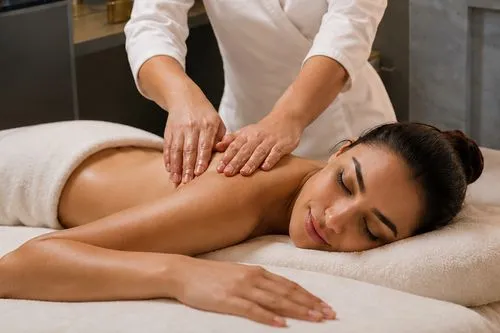
Lymphatic drainage is a slow, very light massage that supports the flow of lymph, the fluid that bathes the tissues and then returns to the blood. In a beauty centre, people choose it for a feeling of lighter legs, a less swollen belly or ankles and a real moment of relaxation. This guide explains what it does, what it does not do, how a session goes, how many to plan and who should avoid it.
What is lymphatic drainage?
Lymphatic drainage is a manual massage technique that helps lymph flow from the tissues towards the lymph nodes. The movements are slow, gentle and repeated, with no deep pressure. The method was developed in the early 1930s by the Dane Emil Vodder and his wife Estrid; it is still known as “Vodder drainage”.
Lymph is a clear fluid that collects water, proteins and cell waste from the tissues. It flows through a network of vessels and lymph nodes, then joins the bloodstream at the base of the neck. This network has no pump like the heart: lymph moves thanks to the contractions of the vessels themselves, those of the nearby muscles and breathing. Valves stop it from flowing back.
Manual drainage supports this natural movement. That is why the pressure stays light: the aim is to move the skin over the tissues underneath, not to massage the muscle.
Aesthetic drainage or medical drainage: what is the difference?
Medical drainage treats oedema, lymphoedema in particular, on prescription and by a trained physiotherapist, most often combined with compression using bandages or sleeves. Aesthetic drainage, carried out in a beauty centre, aims at comfort and well-being: a feeling of lightness, relaxation, a less swollen figure.
| Aesthetic drainage (beauty centre) | Medical drainage (physiotherapist) | |
|---|---|---|
| For whom | heavy legs, temporary water retention, wish to relax | lymphoedema, swelling after surgery or an injury, lipoedema |
| Setting | no prescription, the client’s choice | on prescription, after a medical assessment |
| Combined with | lifestyle: walking, movement | compression, exercises, skin care |
| Rhythm | spaced-out sessions or a short package | 4 to 5 sessions a week in the intensive phase |
In the medical setting, the Geneva University Hospitals recommend manual drainage for lymphoedema, swelling after surgery or an injury, lipoedema or haematomas, as part of a broader treatment. A 2015 Cochrane review of lymphoedema after breast cancer also shows that compression does most of the work in reducing the swelling; drainage can add a modest benefit to it.
A beauty-centre treatment therefore never replaces medical follow-up. If you have diagnosed lymphoedema, your doctor or physiotherapist decides on the treatment; a well-being session can, at most, be added to it with their approval.
What are the benefits of lymphatic drainage?
In a beauty centre, lymphatic drainage mainly brings a feeling of lighter legs, a less swollen body in cases of temporary water retention, and deep relaxation thanks to the slow rhythm of the movements. On the face, it can reduce puffiness and give a more rested complexion. These effects can be felt, but they are temporary.
It is important to be honest on this point. The Cleveland Clinic, an American academic medical centre, says so clearly: without lymphoedema, you may not see significant results, even though the treatment is not dangerous in most cases. As for “eliminating toxins”, that is not a proven effect: what drainage moves is water.
What you can expect from a session, then, is well-being: feeling lighter, more at ease in your body, and giving yourself an hour of calm. That is already a lot, as long as you do not ask more of it.
Does lymphatic drainage help you lose weight?
No. Lymphatic drainage does not burn fat and does not make you lose weight. It can reduce swelling caused by water retained in the tissues, around the belly or in the legs, which gives an impression of a slimmer figure. This effect comes from water, not fat mass, and it is temporary.
Losing weight for good comes through diet, physical activity and, if needed, medical follow-up. Drainage can accompany this change by bringing comfort, especially to the legs, but it does not replace it. For orange-peel skin and firmness, other treatments target the tissue more directly, such as LPG Endermologie, which also has its limits.
How does a lymphatic drainage session go?
A session begins with a conversation about your expectations and your health, to rule out contraindications. The practitioner first stimulates the lymph node areas (neck, armpits, groin creases), then works up the limbs with slow, rhythmic pressures, always towards these nodes. The skin should not redden and the treatment does not hurt.
The principle is to “empty” the areas close to the lymph nodes first, so that fluid further away can then be drawn towards them. The movements are gentle pressures, pumping motions and circular movements, repeated several times in the same place. There is no kneading and no friction: drainage that leaves the skin red or warm is too firm.
At Vernal, a body drainage session lasts one hour. You can go back to your activities straight afterwards.
How many lymphatic drainage sessions do you need, and how often?
In a beauty centre, there is no standard frequency: most often you have a series of closely spaced sessions, for example one or two a week, then maintenance sessions further apart. In the medical setting, treating lymphoedema is much more intensive, with four to five sessions a week during the decongestion phase.
At Vernal, lymphatic drainage is available as a single session or as a 10-session package. The rhythm depends on what you are looking for: relieving heavy legs during the summer does not call for the same schedule as a monthly moment of relaxation. It is decided at the first appointment, with the practitioner.
A single session mainly gives an immediate feeling of lightness and relaxation. To keep the benefit, regularity matters more than intensity, and lifestyle does the rest: walking, moving, avoiding sitting or standing still for hours.
How much does a lymphatic drainage session cost?
The price of lymphatic drainage depends on the length of the session, the area treated and the setting: a beauty centre or a physiotherapist on prescription. At Vernal, in Tangier, a 60-minute body lymphatic drainage session costs 600 dh, and the 10-session package 5,400 dh, that is 540 dh per session.
| Treatment at Vernal | Duration | Price |
|---|---|---|
| Lymphatic Drainage (body) | 60 min | 600 dh |
| Lymphatic Drainage Package | 10 sessions | 5,400 dh |
| The Detox · Radiance Drainage Massage (face, neck, décolleté) | 60 min | 800 dh |
Up-to-date prices on the Body massages page.
Vodder drainage or the Renata França method: what is the difference?
Vodder drainage is the original method: very light, slow pressures that follow the path of the lymph. The Renata França method, created by a Brazilian beautician, combines drainage movements with body-shaping manoeuvres; the beauty centres that practise it describe it as firmer and faster.
No study compares the two methods. The promises of “immediate results” that often come with the Brazilian method reflect the same effect as any drainage: a less swollen figure, due to water, and temporary. The choice mainly comes down to what you are looking for, the relaxation of a very gentle touch or the feeling of a more invigorating massage, and to the contraindications, which are the same.
How do you know if you need lymphatic drainage?
A beauty-centre drainage may suit you if your legs feel heavy at the end of the day, your ankles are a little swollen after standing for a long time or after a trip, or you simply want a gentle, restful body treatment. However, some swelling is a matter for a doctor, not a beauty centre.
See a doctor before any treatment if swelling:
- appears on one side only (a single leg, a single arm);
- came on suddenly, or comes with pain in the calf;
- is red, warm or comes with a fever;
- comes with shortness of breath;
- has lasted several days with no explanation, or appears after surgery or cancer treatment.
These signs can point to phlebitis, an infection, a heart problem or lymphoedema, which need a proper diagnosis and treatment.
Who should not have lymphatic drainage?
Lymphatic drainage is contraindicated in cases of unstabilised heart or kidney failure, recent phlebitis or thrombosis, acute infection with fever or a skin infection such as erysipelas. The Cleveland Clinic adds a history of stroke. The assessment before the first session is there to check for these.
In cases of heart or kidney failure, moving more fluid into the circulation can overload the heart or kidneys; in cases of phlebitis, the massage may dislodge a clot. Other situations call for medical advice beforehand:
- Hyperthyroidism: a relative contraindication, to discuss with your doctor.
- Cancer, during or after treatment: drainage does not spread metastases, according to the Geneva University Hospitals, but no treatment is done on a tumour or on skin damaged by radiotherapy. Your oncologist’s approval is essential.
- Pregnancy: ask your doctor or midwife for advice first.
- After surgery, including cosmetic surgery: post-operative drainage is done on the surgeon’s prescription, who sets its timing and rhythm.
If in doubt, ask your doctor’s advice before booking: it is a simple precaution.
Lymphatic drainage at Vernal, in Tangier
Vernal, a holistic beauty centre on Route de l’Abattoir in Tangier, offers body lymphatic drainage as a 60-minute session at 600 dh, or as a 10-session package at 5,400 dh. The centre is open Monday to Saturday, from 11 am to 10 pm.
The session begins with a conversation about your expectations and your medical history, to choose the right treatment. For the face, “The Detox” massage decongests the face, neck and décolleté.
Frequently asked questions
What is the best exercise for lymphatic drainage?
Walking, first of all: with every step, the calf muscles contract, squeeze the vessels and push the lymph upwards. Cycling also works the calves. Deep breathing, which engages the diaphragm, helps too. Regular activity matters more than an intense session every now and then.
Can I have lymphatic drainage while pregnant?
Ask your doctor or midwife for advice first, and tell the practitioner you are pregnant before the session. Sudden swelling of the legs, face or hands during pregnancy should be shown to a doctor, not treated in a beauty centre.
Does lymphatic drainage hurt?
No. The pressures are light, slow and rhythmic; they should neither redden the skin nor cause pain. If an area is sensitive, say so during the treatment: the practitioner will adjust the pressure.
Are there any side effects after a session?
They are rare. Some people feel temporarily tired, more rarely a headache or nausea. If these effects last or come back after every session, talk to your doctor before continuing.
Can I do lymphatic drainage myself?
Simple self-massage techniques exist, but they should be learned from a professional, especially if you have lymphoedema: a physiotherapist trained in drainage can show you. They replace neither a full session nor a prescribed treatment.