Facialist: what she does, and what sets her apart from a beautician and a dermatologist

“Facialist” has found its place in beauty institutes and on social media within a few years. The word remains vague: it gets confused with beautician, sometimes with dermatologist, and it has no official definition. This guide explains what a facialist does, what sets her apart from the other two professions, when to see a doctor rather than her, and how to check the training of the person you entrust your face to.
What is a facialist?
A facialist is a face practitioner who works mainly with her hands. She observes and palpates the face, then builds a made-to-measure treatment with massage techniques such as Kobido, gua sha, facial stretching or drainage. It is not a health profession, and in France no state diploma bears that name.
The term came from the United States, according to two French schools that train people for the profession, and has only spread in France recently. The Studyrama careers guide describes the facialist as a facial care specialist who uses non-invasive manual techniques and who, unlike a beautician, focuses solely on the face.
What does a facialist do during a session?
A session begins with a reading of the face: its shape, its volumes, tense areas such as the jaw, puffiness around the eyes, the firmness of the tissues. This observation, both visual and tactile, guides the choice of movements; it is in no way a medical diagnosis.
Then come the techniques, chosen and dosed according to what she has found:
- Kobido, an invigorating, rhythmic Japanese massage;
- gua sha, a flat stone glided over oiled skin;
- facial stretching, slow stretches of the muscles;
- facial lymphatic drainage, light movements that support the flow of lymph;
- facial gym, exercises that work the facial muscles;
- depending on the training, cupping or a massage of the inside of the mouth.
Many facialists end the session by showing you a few self-massage movements to repeat at home between appointments. The differences between Kobido, gua sha and natural lift are detailed in our guide to facial massage, and drainage in our guide to lymphatic drainage.
Some facialists follow a named method. The LB Facialistes method, for example, was designed by Delphine Langlois and Catherine Bourgeois. Its creators describe it in three stages: a morphofacial reading of the face, a made-to-measure massage combining the most suitable techniques, then personalised self-massage movements.
What is the difference between a beautician and a facialist?
A beautician takes care of the skin of the face and body, body hair and nails: facials, hair removal, manicures, make-up, often using products and devices. A facialist works only on the face, the neck and sometimes the décolleté, mainly by hand. The two professions overlap: many facialists are beauticians first.
Both adapt the treatment to the person; they do not start from the same place. The beautician first reads the skin, dry, sensitive or mature, and chooses products, devices and massage accordingly. The facialist first looks at the muscles, tensions and volumes of the face, and responds to them by hand.
| Beautician | Facialist | Dermatologist | |
|---|---|---|---|
| Status | beauty profession, with beauty diplomas | beauty profession, with no diploma of its own | specialist doctor |
| Area | face, body, body hair, nails | face, neck, sometimes décolleté | skin, scalp, nails, mucous membranes |
| Starting point | the condition of the skin | muscles, tensions, volumes | symptoms, lesions |
| Tools | products, devices, massage | the hands, stones, cupping | examination, prescriptions, medical procedures |
| Skin diseases | no | no | yes |
Facialist or dermatologist: who should you see?
See a dermatologist as soon as something unusual appears or changes on your skin: acne, a mole that changes, patches, persistent redness, hair loss. A dermatologist is a doctor who diagnoses and treats. A facialist works on healthy skin, for relaxation, comfort and the appearance of the face.
According to the French Society of Dermatology (Société française de dermatologie), a dermatologist is a medical doctor specialising in diseases of the skin, nails, scalp and mucous membranes. Dermatologists examine, can take a small sample of skin to have it analysed under the microscope, prescribe treatments and monitor their effects. Facial redness such as rosacea or broken capillaries, eczema, brown or white spots and skin cancers fall within their field.
They are also the specialists in the aesthetics of the skin, and some dermatologists perform peels, laser treatments or injections of botulinum toxin and hyaluronic acid. These medical procedures are outside the scope of a facialist, who injects nothing and prescribes nothing.
If you are following a treatment prescribed by a dermatologist, or have recently had injections, ask your doctor how long to wait before a facial massage, and let the practitioner know.
Is the title of facialist regulated?
Not in France, where the term has spread: no state diploma or training listed in France’s official register of professional certifications (RNCP) bears that name. Facialists train in private schools, often after a beauty diploma. The word alone therefore says nothing about the training received: that is what you need to look at.
Before booking, you can ask:
- what training the practitioner has completed;
- which techniques she actually practises in the treatment room, and which ones she suggests for you;
- how many sessions she has in mind, and what she expects from them, in plain terms;
- in which cases she would refer you to a doctor.
A training certificate states the teaching received and the organisation that provided it; it is neither a state diploma nor a medical qualification.
What can a facialist treatment change?
In the moment, a session relaxes you and gives you a healthy glow: small studies have measured a temporary increase in skin blood flow after roller massage. On the shape of the face, the evidence is thin. One study of facial exercises done at home shows how thin: sixteen women, with no comparison group.
Published in 2018 in JAMA Dermatology, a journal of the American Medical Association, it followed women aged 40 to 65 trained in 32 exercises, which they did themselves at home after two 90-minute learning sessions: 30 minutes a day for 8 weeks, then every other day until week 20. Of 27 participants, 16 completed the study. Two doctors, rating the photos blind, judged the cheeks fuller; the estimated age, also assessed blind, went from an average of 50.8 years at the start to 48.1 years at the end.
The authors point out its limitations: few participants, many dropouts, no comparison group, volunteers who were already motivated. The creator of the method tested was one of the authors. The study concerns neither a massage nor a session in an institute. What is known about facial massages is summarised in our guide to facial massage.
The facialist at Vernal, in Tangier
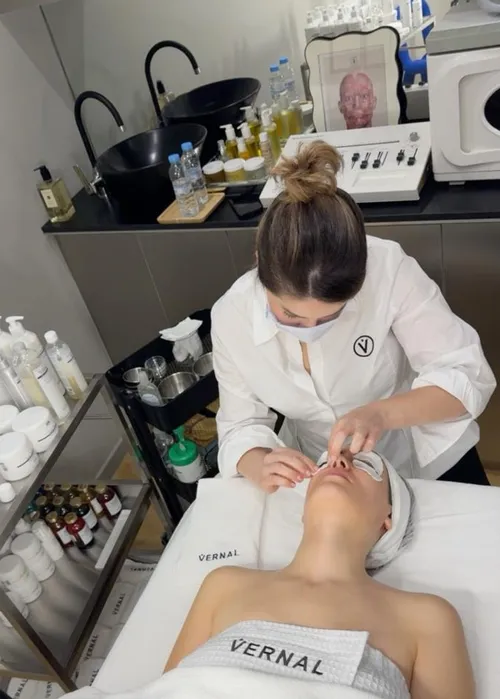
At Vernal, a holistic beauty centre on Route de l’Abattoir in Tangier, the facial massages are designed and performed by Hajar Dabbou, facialist in Tangier and founder of the centre, trained in the LB method, Kobido and facial gym. Treatments are for women only.
| Treatment at Vernal | Duration | Price |
|---|---|---|
| Face Gym · LB Facialiste Method | 30 min | 500 dh |
| The Detox · Radiance Drainage Massage | 60 min | 800 dh |
| The Kobido Ritual · Japanese Lifting Massage | 60 min | 1,000 dh |
| Signature Vernal · LB Facialiste Method | 75 – 90 min | from 1,200 dh |
The full menu is on the Facial massages page. For a treatment built around the condition of the skin and products rather than technique, Vernal also offers Biologique Recherche treatments, with a personalised skin diagnosis that can be booked on its own for 250 dh; everything is brought together on the facial treatments in Tangier page.
Frequently asked questions
What is a facialist treatment?
It is a facial treatment centred on manual work: the practitioner observes and palpates the face, then combines techniques such as Kobido, gua sha, facial stretching or drainage, depending on what she has found. The products support the movements rather than being the main treatment.
Can a facialist treat acne?
No. Acne is one of the skin diseases treated by a dermatologist, who can prescribe treatment. A facialist does not make a medical diagnosis. If your skin is in an inflammatory flare-up, see a doctor first, then ask whether a manual treatment is possible.
Do you need to be a beautician to become a facialist?
No diploma bears the name facialist. In France, most facialists start with a beauty diploma, such as the CAP (a vocational qualification), then take private training courses in facial massage, anatomy and manual techniques.
How much does a session with a facialist cost?
The price depends on the duration and the technique. At Vernal, in Tangier, an LB method facial gym session costs 500 dh for 30 minutes, Kobido 1,000 dh for an hour and the Signature LB method treatment from 1,200 dh, for 75 to 90 minutes.